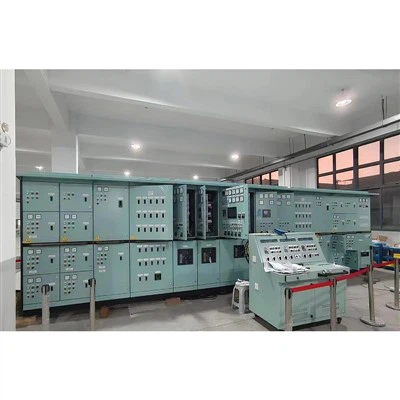
Digital Signal Processing: Receives switching signals from sensors and buttons (such as limit switches and emergency stop buttons), and outputs switching signals to control the start and stop of actuators such as contactors and solenoid valves.
Analog Signal Processing: Acquires continuously changing analog signals (such as 4-20mA current signals and 0-10V voltage signals) such as temperature, pressure, flow rate, and liquid level through analog modules. After processing by the PLC, it outputs analog signals to achieve continuous regulation of equipment such as frequency converters and regulating valves.
Motion Control: Control cabinets equipped with dedicated motion control modules or bus-type PLCs can achieve precise control of servo motors and stepper motors, supporting point-to-point control, linear interpolation, circular interpolation, and other functions. Suitable for high-precision motion scenarios such as CNC machine tools, automated packaging equipment, and robots.
Interlocking and Protection Control: Implements safety interlocking and fault protection between equipment to prevent misoperation or escalation of faults.
Interlocking Control: If the fan is not running, the heater cannot be powered; if the conveyor belt is overloaded, the upstream feeding equipment will automatically stop.
Fault Protection: When faults such as motor overload, excessive pipeline pressure, or leakage are detected, the PLC immediately cuts off the power to the corresponding equipment and triggers an alarm.